Biola University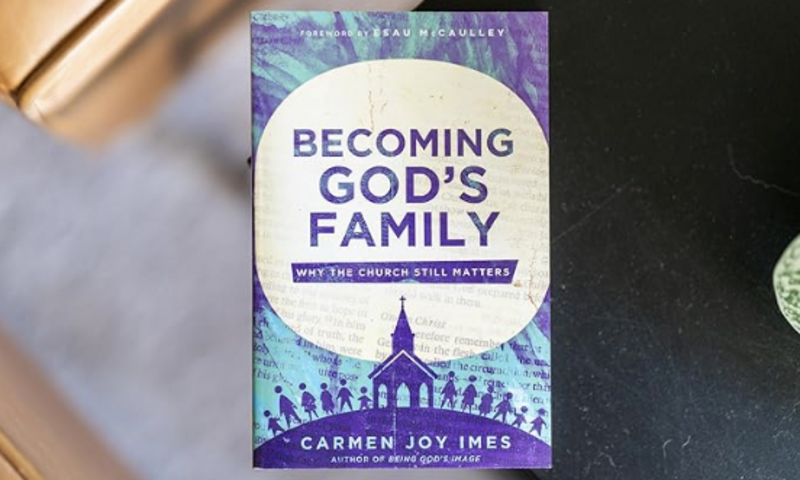
Carmen Imes is on a bit of a roll lately.
You may have seen mention Carmen Imes regarding her last book, . It’s a great resource, and now she has a follow-up book, out in November 2025.
Also, just this week [Week of November 30] , that book,
And finally, a lesser-known radio host just had her on to .
It’s called “,” and is a beautiful call to care for and be a part of the church.
The publisher’s description explains,
After waves of disillusionment, #churchtoo movements, and political divides, it’s easy to question the value of investing in the church. Yet Carmen Joy Imes offers a profound answer that resonates through the pages of “Becoming God’s Family.” Exploring the familial and communal identity of the church, Imes traces the thread of God’s presence in the gathered community of faith across the entire Bible. She invites readers into a vision of the church that is rooted deeply in Scripture and speaks directly to the challenges we face today. Imes reminds us of a powerful truth―God delights in the global, intergenerational family He has created.
I had the joy of reading and endorsing the book, and here’s my endorsement:
One of the longest studies ever conducted on human life — the Harvard Study of Adult Development — found the top factor in living a long, happy life is deep relationships in a healthy community. As believers we know this is near to the heart of God, who gave us the church as a spiritual family. Carmen Imes gives a strong and needed call to this community in our land marked today by individualism and division.
Here are 20 truths from “Being God’s Family.”
20 Truths From Becoming God’s Family
“The overarching narrative of the Bible is singularly focused on forming a faithful community of people who worship and wait for God while carrying out his mission in the world.” (8)
“Biological children do not need to be adopted by their biological parents. If all humanity is already part of God’s family, then adoption is not necessary. However, adoption is the best word available to Paul to describe to a collectivist audience the radical change in allegiance that comes with faith in Jesus.” (14)
“…God’s promises are not aimed at helping us reach our personal goals. Instead, God’s promises transcend our personal lives and stretch wide to encompass others we will never even meet.” (18)
“…the tabernacle is essential to biblical theology because it resolves the separation between God and humanity that resulted from Adam and Eve’s decision to disregard God’s command. Their expulsion from the garden introduced the major plot conflict of the Bible, in search of resolution. How can humanity reunite with our ?” (21)
“The book of Leviticus is crucial in resolving the problem left hanging at the end of Exodus — Moses’ inability to enter the tabernacle (). After Leviticus, the book of Numbers opens with a comment about God speaking to ‘in the tent of meeting’ (). Fellowship is restored and the community is ready to move forward.” (25)
“David’s victory over Goliath was not only a personal achievement, but a national triumph. It vindicated Yahweh’s might and rallied the kingdom in celebration. The point was not David’s age or size or strength, but his absolute trust in Yahweh and his concern for Yahweh’s reputation.” (43)
“It takes tremendous effort to pursue the truth about ourselves, rather than to surround ourselves with people who will stroke our ego and rubber-stamp our ideas. When we become part of God’s family, our shared task is to pursue God’s will together. To do that we must become a community that speaks truth to each other in love ().” (54)
“What could the Spirit do with a community that is honest about our propensities toward distraction or the numbness we feel toward the world’s problems? What if we prayed together in desperation for an end to the wars that ravage the nations of our world?”(55)
“When we gather for , among the many other things we’re doing, we are cultivating shared attention. Watching a on demand from the comforts of my own home can never quite accomplish that.” (68)
“Our children need to know about the challenges we’ve faced and how God helped us to overcome them. Remembering trauma reminds us that we are shaped by what has happened to us and also that we have moved on and found life and hope again. Knowing that can help our communities face fresh wounds with courage.” (74)
“Praise is what unites and makes possible the radical transformation God has in mind for us. It inaugurates a new kind of community under the rule of our gracious King.” (76)
“By personally praying psalms of praise and lament from the Bible, we develop the habit of bringing our deepest needs to God and of celebrating his work in our lives. The Psalms shape our capacity to pray by providing model prayers with both depth of feeling and breadth of topics.” (77)
“The purpose of the law was to facilitate Israel’s mission to be a light to the nations. Others should be able to watch Israel to see Yahweh’s character and values on display.” (102)
“If we read Romans backwards, sets the stage for the kind of churches Paul commends — those marked by collaboration in ministry from a wide variety of people, including both men and women.” (107)
“Paul’s vision is a dinner table where we pursue people who are not like us with the goal of becoming knit together as a family. What if the goal of our social calendar was to eat with people who think differently than we do? What sort of world would this be if we moved toward those whose views challenge our own, rather than moving away from them?” (108)
“The global church can bear prophetic witness to the theological distortions of the American church (and vice versa!), helping us to perceive the ways we have absorbed the values of our culture rather than embodied gospel values.” (112)
“Participating in a church community is not an extracurricular activity for those who want to be ‘super Christians.’ Instead, church participation is the central means by which every Christian becomes part of God’s family and participates in God’s kingdom.” (120)
“On our own, any one of us is incomplete. We are meant to join with others to become something more than we can be by ourselves. We gather prayerfully, serving one another and waiting for God to act among us. God chooses this community in which to tabernacle and to manifest his presence to the world.” (122)
“Our doctrine may be precise and our church planting methods sound, but if we don’t like people in our church, they will not entrust themselves to us, nor we to them. Paul models fondness in so many ways as he longs to be with those with whom he has shared the gospel.” (126)
“A single vocalist, no matter how talented they are, is unable to produce the full and complex harmonies of a choir … This is also true of the church.” (130)
and other writings by Ed Stetzer can be found on .